Pascale Petit - Issue 11

Ekphrastic Poetry, Trauma, and the Gift of Art
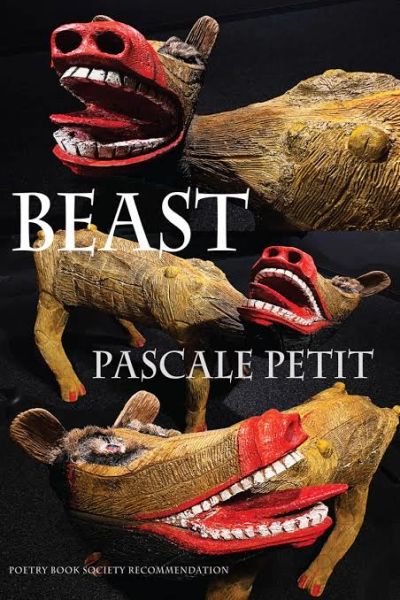
Pomegranate sat down with award-winning poet Pascale Petit to talk about the meeting point between art and poetry. Trained as a sculptor at the Royal College of Art, Petit has spent much of her life moving between visual art and the written word, with four of her earlier collections shortlisted for the T.S. Eliot Prize and her latest, 'Beast' (Bloodaxe, 2025), a Poetry Book Society Recommendation. Her ekphrastic work, including 'What the Water Gave Me: Poems after Frida Kahlo', explores how images can open up unexpected ways of approaching memory, trauma and the self. We spoke about the artists who have given her a way into difficult experiences, the challenge of making an ekphrastic poem stand independently from the artwork, and how art can transform pain into beauty. For Petit, when two artists meet across different forms, one is offering the other a gift, and an invitation into the imagination zone.
Is there a specific moment looking at an artwork when it becomes the beginning of a poem?
Pascale: It isn’t always the artwork itself that triggers the poem. For example, I have always been drawn to Frida Kahlo’s paintings. I used to think I’d never be able to write about them, but then I read the introduction to her diary by Carlos Fuentes. He said that she was raped by a bus during the terrible accident when she was eighteen, the trolley car collision that damaged her severely and required many surgeries. Because I have written a lot about trauma, child abuse, and my own parents, I thought, here is a way to write about that without blaming a specific person or involving a perpetrator directly. I could write about it by looking at how she dealt with such a terrible event through painting, through the pain, making it vivid and full of life force. That was my way in.
I wrote my first two poems from that collection, which began as a pamphlet called ‘The Wounded Deer’ before becoming part of ‘What the Water Gave Me’. One poem, ‘Remembrance of an Open Wound’, is about a drawing she made of the accident’s impact on her body. Once I realised I could write about adult themes through that lens, rather than just childhood, I found I could also explore sex, sexual jealousy, and how one deals with trauma in art. Frida surrounded herself with colour and animals, so it was perfect for me. The poems in the book are kind of half-and-half, they wear a mask, which in a way reveals more. Masks often reveal more of yourself, but they also provide safety.
Is there something you look for specifically when you come across a painting or sculpture?
Pascale: It changes quite often. Sometimes it takes me years to be able to write a poem about a piece. For instance, in my latest book, ‘Beast', there is a poem called ‘Concert for Motherhood’ based on Rebecca Horn’s ‘Concert for Anarchy’. I first saw it at Tate Modern when it opened, a grand piano hanging upside down from the ceiling and making a lot of noise. I thought, gosh, that is such a poem. Rebecca Horn had even written a poem about it.
What I want to do in a poem is create a sculpture, or an installation, or a painting with words. So I wanted a poem that had the chaos of that piano. Then I started thinking about my real relationship with pianos. I remembered living with my grandmother in Mid Wales. We used to visit a farm across the back field where there was a piano. My brother and I would go there, and I would play on it without any idea how to, making discordant noises, bouncing up and down on the beds, all those things kids do. Later, after my mother died, I found letters my grandmother had written to her, asking if we could get a secondhand piano for me. My mother lived in Paris, and it turned out it just wasn’t possible.
Then I remembered my very first experience of a piano, being in a children’s home when I was five, sitting on the floor beneath a grand piano. I remember all the feelings of being in the institution, the longing for my parents to come and visit. I wrote the poem about being in the children’s home, the madness of my mother and how scared I was of her, as a child and as teenager, and in fact all my life, until she died.
Have you ever felt that an artwork has resisted your attempt to write about it?
Pascale : Many, many times. The very first one was Van Gogh. I loved his paintings intensely, but I just couldn’t write well about them. I’ve since seen other poets do really good work on him, but he totally resisted me. I even went to Arles in Provence, visited the asylum where he was interned, and saw the views from his window and the bathtubs they used for cold baths. But no Van Gogh poems came from that.
In fact, there are many artists I love whom I haven’t succeeded with. I have a list! I did write about Louise Bourgeois, though it took a while. Seeing her large spider sculpture, ‘Maman’ was such a way in for me because I call my mother ‘Maman’. Bill Viola’s videos are another area where I love the work but can’t write poems about it. I don’t know why.
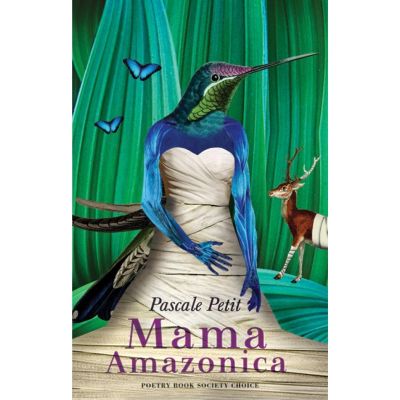
There is a Peruvian plant shaman called Pablo Amaringo. In 2000, I was finishing ‘The Zoo Father’ and staying in a friend’s hut near the sea. I took his book, ‘Ayahuasca Visions’, because it spoke to me. There’s a poem in my collection 'Mama Amazonica' called ‘Anaconda’. It’s one of the simpler ones featuring a mythical giant snake called Sachamama. Anacondas are usually giants, but this one is the size of a tree. She moves so slowly that trees grow on her. It also shows a deer that it’s mesmerising with its eyes, drawing it to its mouth. Deer is probably my favourite animal in the world, and I love snakes too because they’re fascinating.
About sixteen years later, I reopened that book. It’s based on Icaros which are singing spells for people who are sick, and that led me to write about depression. I thought, how can you write about depression in a way that’s exciting and not too depressing? I wrote ‘Anaconda’ about my mother, and I’d already experienced depression myself.
I have to be very excited about an image to be able to write a poem. I mean, I really have to absorb it. I taught creative writing for nine years on Monday evenings at Tate Modern, leading classes responding to artwork. The strange thing is, in that time, I only wrote two poems, whereas my students wrote many. I think all my energies went into finding ways for them to succeed.
There’s also Francis Alÿs, the artist who chases tornadoes in the desert. I saw a video of him going into the heart of a tornado. I found that very exciting and terrifying. I am an adventurous soul in a very unadventurous body. The body just likes its comfort.
Do you feel that an ekphrastic poem should stand independent of the artwork that inspired it?
Pascale: Yes, I do. When I published ‘What the Water Gave Me’, Seren Books offered to do a bigger book with reproductions of the Frida Kahlo paintings. It would have been expensive for them, and they wouldn’t have matched every poem with an image, but they offered. I had a long think about it and said no. What I’m trying to do in my poems is create a poem version, an alternative version of the painting, and of how she used painting to transform trauma.
However, when I launched the book, I showed slides of the paintings because it makes the work more accessible and rich for people outside the poetry world. I tell my students that an ekphrastic poem must stand on its own and should not need the artwork.
I remember sending some poems to The Rialto, who usually publish my work and have been very supportive. Michael Mackmin said, “I don’t publish ekphrastic poems.” I don’t know if he still feels that way. But there is a valid point: it tells readers the poem is about something they may not know, that the poem is about something external.
Do you feel something happens when two artists meet across different forms?
Pascale: I think one creator is offering a gift to the other. You don’t have a blank page, you’ve got a gift. You’re also responding to their work. Maybe it’s an attempt to cross the barrier between words and image, getting into that mysterious arena of where art comes from, or what the imagination is trying to do. It’s like a meeting in the imagination zone.
After decades of publishing poetry, are you discovering something new about yourself as a writer?
Pascale: I don’t feel I’ve written my best work yet, and I may never do so. I just keep trying. I’m hoping my next book, which I’m about three-quarters of the way through, will be my best. We probably all think that about our next books, but I’ve really pushed for this one.
I believe art, and therefore poetry, is the human mind trying to push into new ways of being and new ways of perceiving the Earth. That’s our home. I have two very specific tasks. One is to try to recreate the Amazon Rainforest in case it vanishes. I’m recreating it in the form of a weaver, a tapissier, weaving a huge tapestry, while her imaginary daughter lives in the canopy, a place I cannot enter because of my fear of heights and vertigo. That is one of my main jobs.
In that work, there is a tussle between bad and good. Looking at the natural world, you see terrible predator-prey relationships. Parasitic wasps lay eggs into hosts like spiders and caterpillars, keeping them alive but paralysed while their larvae grow inside them to feed. It’s incredibly cruel. My parents were cruel to me, so a lot of my work examines that relationship: why cruelty exists, what can be done about it, and how beauty can be made out of it. I look at nature not entirely as a place of wonder, but also at its cruelty. The relationship between prey and predator interests me deeply.
Has your idea of what constitutes a successful poem changed?
Pascale: It has shifted. When I was writing ‘The Zoo Father’, I wanted my poems to shock, to have an element of surprise. I wanted the image to carry that surprise. I’m still trying to do that, not the shock part so much, but definitely the surprise. But I think I’m searching more for beauty now. Rather than focusing on the trauma aspect, I want beauty attached to it.
Is there something you believe about art & poetry that you didn’t when you first began writing?
Pascale: When I started out as an artist, I felt my sculptures were more alive than me. I didn’t want to live my life; I wanted to pour my life force into my art. I felt my life was hopeless at that point. It was a dichotomy: either all art or nothing. I don’t think that anymore, although I still feel that my books are more “me” than the human being I am at a party.
When I went to art school for my degree, I had a little book of poems that came out at the same time as my exhibition. I was trying to write about alienation because I was a very alienated person, and the poems were really obscure. I soon learned that’s no good. And when I was writing my first book, ‘Heart of a Deer’, I started writing about my parents through ice and the rainforest and the Amazon, which I had visited by then. But I would say there was too much foliage in that book. When I wrote ‘The Zoo Father’, I learned about the rapidity of a line, about making a poem more dynamic and direct. That was something I learned twenty-six years ago.
Since then, I just carry on learning. I learn about line breaks every time I read a good poet. All that happens is that I read more and more poets, revealing different ways of writing. I’ve read more generally, traveled more, and lived more.
When I started writing, I also had no idea that nature, the wilderness, was so threatened. The underlying theme in my next book is climate change. It’s just incredible how speedily it’s progressing. There is a feeling of having to capture life, what it is to be human on Earth, before it’s too late.
Is there anything you’ve become more willing to write about over time?
Pascale: I’m happy for people to read ‘The Zoo Father’. Apart from the first poem and a couple of others, I wouldn’t want to read them aloud anymore. I’d have a shock if I did. It doesn’t invalidate them, it’s just that I prefer to read poems that have beauty in them. Horror and terror are okay, but more beauty. I prefer a personal approach with more beauty attached to it, rather than pure exposure. Even in ‘Beast’, my latest book, there are a few very exposing poems. I read them because I think they might be some of the strongest poems. But afterwards, I just feel really exposed. I ask myself, “Did I have to read that? Did I have to write it?”
What can poets learn from artists working in other disciplines, and vice versa?
Pascale: When I was teaching at Tate Modern and looking at artwork, I was looking for an image that will refresh my palette of images. That’s what students get out of it too, instead of using their usual palette of colours, they get new colours into their work, which might prompt a new poem. Poems can be hard to get out of nowhere.
Also, visual artists, especially installation or sculptural artists, have access to other senses: smell, sound, weight, the organic sense, inner body sensations, and movement. These help flesh out a poem so it’s not just seen in the reader’s head, but is a real visceral thing. That’s what poets possibly get from visual art. And, of course, music and dance offer all kinds of movement and emotion.
What can a visual artist get from a poet? Poets have the advantage of time in a poem. You can really play with time. It’s harder to do that in a static painting or sculpture. Also, poetry can be more directly personal.
Do you have the time and interest in making sculptures again?
Pascale: I’m 72 now, and there are poems I need to write, maybe a second novel. There’s only so much time. I don’t want to split my attention. When I was a sculptor and a poet, I would spend a year as one, then flip and become the other. I’d be quite absorbed in one form and not at all interested in the other. Sculptures take an awful lot of energy, especially full-size. I’d become very focused in that art form, with not much space for anything else.
Whenever I hit a barrier in poetry, and I did, many barriers, instead of pushing through, I would say, “Right, now I’m going to be a sculptor for a year.” It was the same with sculpture: “Oh, well, never mind, I can write poems.”
When I stopped making sculptures, I couldn’t give up art because I needed to survive. I needed to make art. So the poems had to get better. I had to read and read more contemporary poets, especially, to find out how to do this thing properly.